Family Justice Center Info Sheet
FJCs focus on providing immediate and holistic long-term support to survivors of domestic and sexual violence and their children, creating communities of safety, support, and healing. The outstanding level of service provided has earned FJCs funding through the Violence Against Women Act (VAWA). Unlike other service approaches that seek to coordinate access to services, FJCs bring service providers under one roof where they provide direct services to adult and child trauma survivors, mitigating obstacles to safety, support, and healing. FJCs have the lowest homicide rate of any intervention strategy.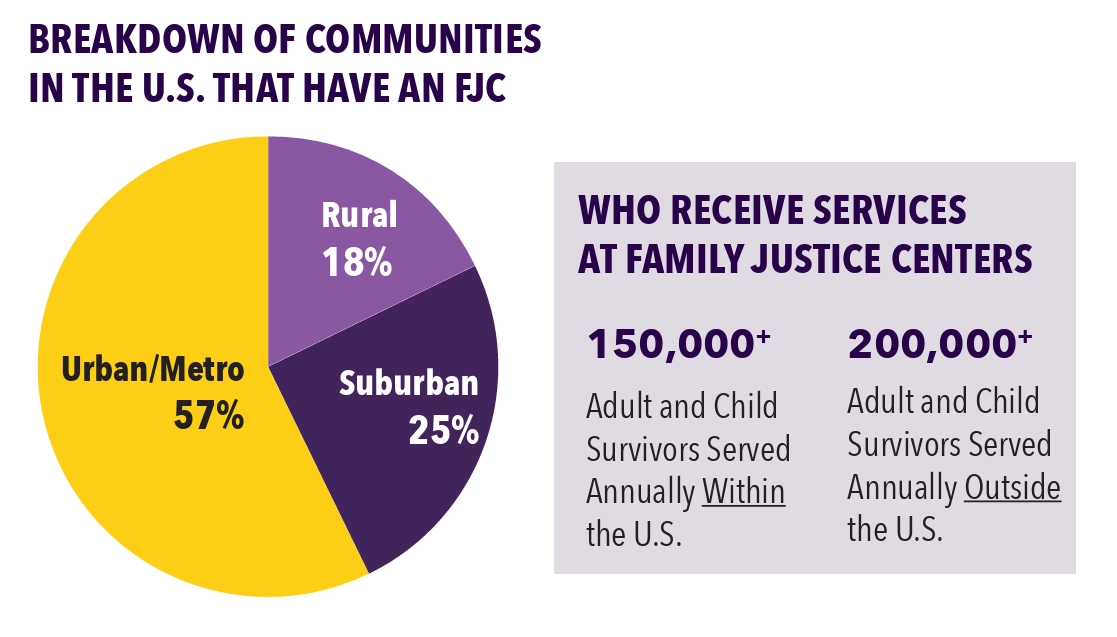
In addition to Federal Funding, FJCs also raise funds through:
• Board Development and Leadership
• Government Integration
• Regional/Statewide Leadership
• Public Engagement and Awareness
• Individual Fundraising
CO-LOCATED SERVICES: FJCs bring together multiple agencies and services under one roof, providing victims with a one-stop-shop for accessing legal, medical, counseling, and social services. This approach reduces the need for victims to navigate multiple systems and locations, streamlining support and enhancing safety.
CHILDREN’S PROGRAMS: Specialized programs for children who have witnessed or experienced violence are a key innovation, including Camp HOPE America. These programs offer mentoring, educational support, sleepaway camp utilizing evidence-based specialized curriculum and recreational activities designed to help children heal from trauma and build resilience.
CULTURAL COMPETENCY INITIATIVES: Recognizing the diverse backgrounds of victims, many FJCs have developed programs that are culturally and linguistically tailored to meet the needs of specific communities. This includes hiring bilingual staff, providing materials in multiple languages, and offering culturally sensitive services.
LEGAL ASSISTANCE AND ADVOCACY: FJCs often provide on-site legal assistance, including help with obtaining restraining orders, custody issues, and immigration matters. Some Centers also offer pro-bono legal services and partner with local law schools to involve students in providing legal support.
ECONOMIC EMPOWERMENT PROGRAMS: These programs focus on helping survivors achieve financial independence and stability. Services may include job training, financial literacy workshops, and assistance with finding employment and housing.
TECHNOLOGY-FACILITATED SERVICES: Utilizing technology to enhance accessibility and safety, some FJCs offer virtual counseling sessions, online legal consultations, and secure communication platforms for victims who may not be able to visit the Center in person.
TRAUMA-INFORMED CARE: Many FJCs implement trauma-informed care practices, ensuring that all staff are trained to understand and respond to the effects of trauma. This approach emphasizes creating a safe and supportive environment that fosters healing and empowerment.
COLLABORATION WITH LAW ENFORCEMENT: FJCs often work closely with local law enforcement agencies to improve the response to domestic violence and other crimes. This collaboration can include on-site police officers, joint training sessions, and coordinated safety planning.
HEALTH SERVICES: Some FJCs have integrated health services, including on-site medical clinics, forensic examinations, and connections to local healthcare providers. This holistic approach addresses the physical and mental health needs of survivors.
HOPE-CENTERED COMMUNITY OUTREACH AND EDUCATION: FJCs engage in extensive community outreach and education efforts to raise awareness about domestic violence and available services. This can include public awareness campaigns, training for community organizations, prevention programs targeting schools and youth groups, and continued services and support after the crisis. These innovative programs exemplify the holistic, collaborative, hope-Centered and survivor-Centered approach that FJCs take to support victims of violence and abuse.
